The Scariest Moment in Event Horizon: No Blood, Just Chill
Let’s talk about the space horror movie that flopped harder than a pancake at a failed breakfast.
Event Horizon—once a box office dud—is now considered a cult classic. Yes, it’s 1997 and it’s both terrifying and strangely entertaining without needing to shower us in blood and guts!
Here’s a fun fact: the version we got to see was toned down by about 30 minutes of wild, gruesome footage after studio heads and audiences collectively screamed “NOPE!” at the first cut. But don’t worry, there’s still plenty of bizarre and creepy moments to give you nice goosebumps.
If you try hard enough (or not at all), you might recall some seriously disturbing images: we’ve got Sam Neill’s Dr. Weir sporting a rather unfortunate facial makeover. Then there’s Chief Engineer Justin, whose eyes resemble a kid’s science project gone wrong in a depressurized airlock. Not to forget D.J. getting vivisected on the operating table—yikes! And let’s not even dive into that blood-chilling footage from the original crew’s video log, which includes a captain casually holding onto his own eyeballs. A real party, right?
But believe it or not, the scariest scene in this sci-fi fright fest doesn’t rely on any of that graphic imagery. Nope! It’s all about what we
don’t see, and it’ll send shivers down your spine.
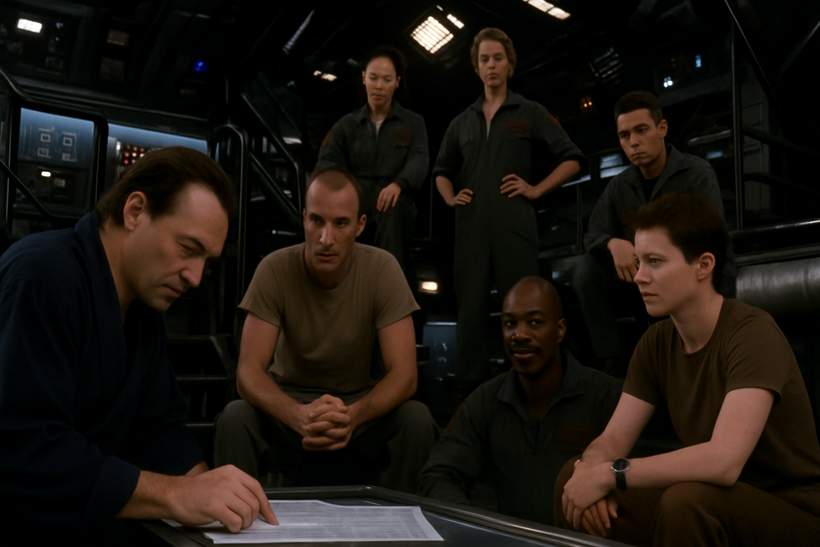
So here’s the setup: Anderson skillfully gathers the crew of the rescue ship
Lewis and Clark for some good old-fashioned exposition courtesy of Dr. Weir, the man who designed the Oh-So-Fun
Event Horizon. The crew is all jokes and banter in their well-lit quarters, making it easy to forget the impending doom. We even meet our ‘gloomy Gus’—seriously, of all the fun nicknames, they went with this—for D.J. (played by the ever-charismatic Jason Isaacs), who’s more Debbie Downer than the rest of them.
Now, picture this: The
Event Horizon went missing seven years ago—mysterious, right? It shows up just hanging around Neptune like it forgot where it parked. So, of course, the
Lewis and Clark has been sent to figure out what’s going on.
Now that we’re all caught up with these brave souls, Anderson pulls a quick switcheroo. Weir is in a darker nook of the ship’s bridge, and the bright lights from earlier are replaced with glowing screens and eerie overhead lights. He cues up the distress signal from the
Event Horizon, and, folks, it’s a cacophony of terror—the worst sounds you can imagine play out like a deranged symphony! Howls, screams, and an agonized voice delivering a desperate call for help.
Smitty, the pilot, pretty much speaks for us all when he blurts out, “What the freaking hell is that?” Weir plays some more audio, and D.J. does the Latin translation as if he’s trying to Hamlet us: “Save me.” Chill, right?
The greatest part? There’s no creepy score to ruin the moment—just the ship’s hum and the horrifying sounds looping on repeat. The moment’s so nail-biting that an alarm blares and suddenly everyone springs into action. It’s a fright-fest they’ll not soon forget—like a rollercoaster ride through Hell that you definitely didn’t sign up for.
This particular scene doesn’t need graphic visuals to create bone-chilling horror. It’s all about what our minds conjure—visions of the horrors that make the crew scream. None of the Lovecraftian monsters we meet later on can quite live up to the sheer dread transmitted by that harrowing distress signal.
Let’s be honest, uncertainty is like a marathon for our fear-triggering instincts. Scientific studies have shown that we get more stressed out in unknown situations than in those where we know we’re going to face something downright terrible. It’s an evolution-driven habit that keeps us from meeting a gruesome fate, and it works like a charm in horror films. This is exactly why we don’t see the witch in
The Blair Witch Project, and it’s the reason
Alien and
Jaws keep their monstrosities lurking in the shadows for as long as they can.
The distress call from the
Event Horizon throws us into a state of suspense almost immediately. What follows is a chaotic mess of horror, but we never quite hit the same fear levels as we do during that bone-chilling signal scene, which cleverly uses sound design to drag us into the depths of our own imaginations.
In the end, let’s remember: where we’re going, we won’t need our eyes to see—just a whole lot of courage!